Renewable Energy
Start of page content
The Renewable Energy Strategy in the City’s Climate Action Plan (CAP) aims to increase supply and access to renewable energy for existing and new residential, nonresidential and municipal facilities. Transitioning from fossil fuels to renewable electricity sources like solar and wind will reduce pollution, including greenhouse gas (GHG) emissions.
To accomplish this, the City’s CAP calls for the launch of a Community Choice Energy (CCE) program, the installation of solar panels on homes and businesses and the addition of solar panels on municipal facilities, among other initiatives. Implementation of these measures is estimated to reduce the City’s GHG emissions by 434 metric tons of carbon dioxide equivalent (MTCO2e) by 2020 and 20,935 MTCO2e by 2030.
Explore the sections below to see what the City is doing to achieve these goals.

RE-1: Establish a Community Choice Energy Program
100% Renewable Electricity by 2030
One of the key goals of the City’s CAP was to launch a CCE program. CCE programs are not-for-profit, local public energy agencies that purchase clean electricity on behalf of residents and businesses. In 2019, the City formed a new CCE called San Diego Community Power (Community Power) along with the cities of San Diego, Chula Vista, La Mesa and Imperial Beach. Community Power’s member agencies now also include National City and the County of San Diego.
As part of the initial roll-out, Encinitas City Council voted to establish Community Power’s premium product, Power100, as the default electricity choice for all customers within the City of Encinitas. The default electricity choice provides 100 percent renewable electricity to customers for a slight premium of $0.01 per kWh on top of their standard PowerOn rates, which offers power that is 53 percent renewable. This action enabled the City to achieve its 100 percent renewable electricity goal well in advance of the 2030 target date.
UNIT | A kilowatt is a measure of power, or how fast something generates or uses energy. The capacity of a solar photovolatic (PV) system to generate energy is measured in watts. Solar PV systems installed on single family homes typically range in size from 5 kW to 20 kW. One kilowatt equals 1,000 watts. | kWKilowatt |
A kilowatt is a measure of power, or how fast something generates or uses energy. The capacity of a solar photovolatic (PV) system to generate energy is measured in watts. Solar PV systems installed on single family homes typically range in size from 5 kW to 20 kW. One kilowatt equals 1,000 watts. | kWKilowatt |
MRE-1: Supply Municipal Facilities with Renewable Energy
Municipal Facilities with On-Site Renewable Energy
CAP measure MRE-1 set an ambitious goal of supplying all municipal facilities with enough onsite renewable energy to achieve “net zero electricity.” This means municipal buildings would generate as much electricity as they consume. The CAP goal is to supply 50 percent of its municipal energy needs from renewable sources by 2020 and 100 percent by 2030.
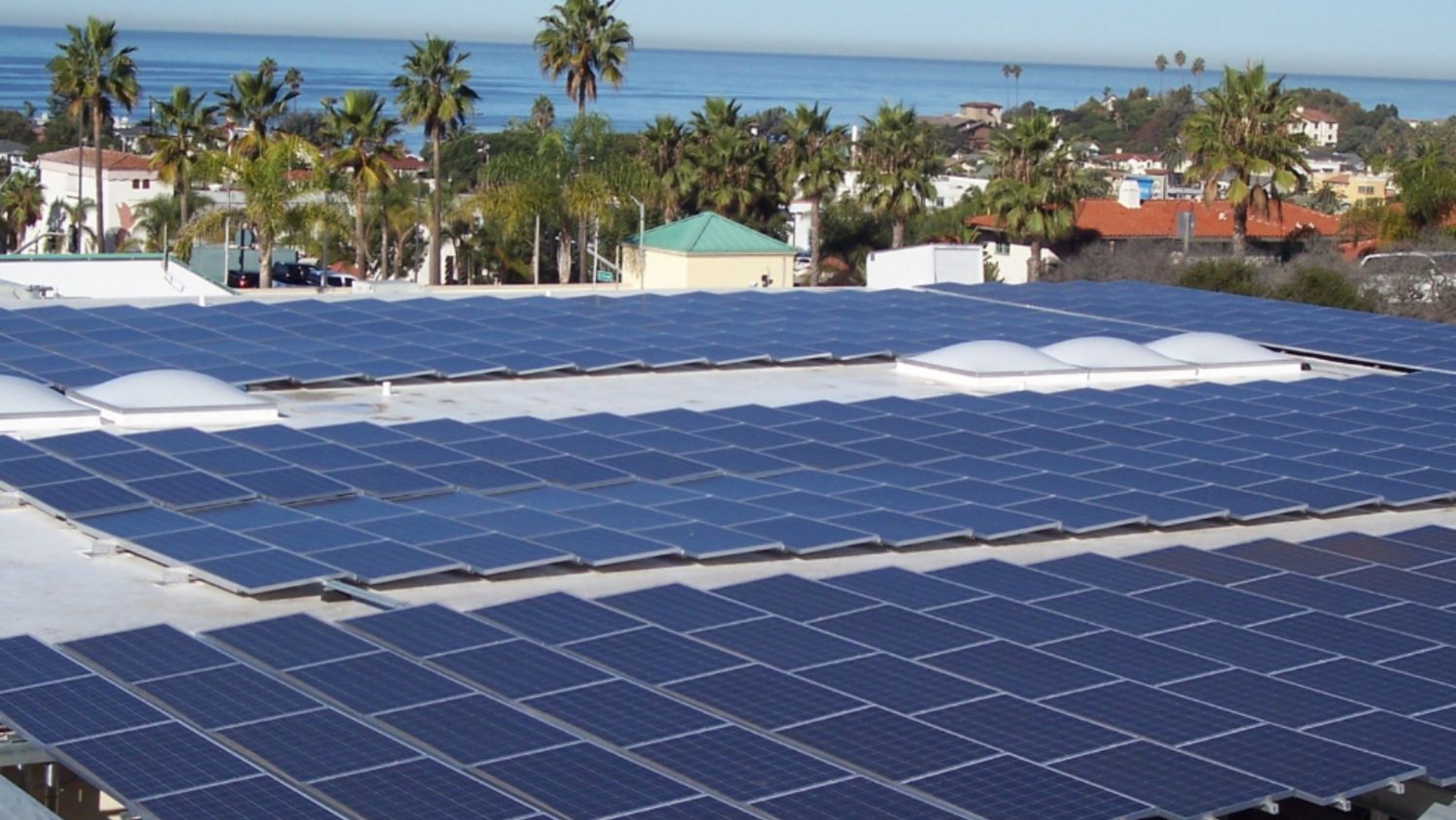
In 2008, the City installed a 96-kilowatt (kW) solar PV system at City Hall. The system generates approximately 150 megawatt hours (MWh) of electricity each year, which is equivalent to about 7 percent of the City’s annual municipal building electricity use.
In early 2025, the Public Works Department initiated the development of a Facilities Condition Assessment (FCA) for the City’s municipal buildings, parks and other facilities to evaluate their physical condition and operational efficiency. This comprehensive assessment will incorporate the long-term goals of the Climate Action Plan and help prioritize repairs, maintenance and upgrades to ensure the City’s municipal facilities maintain adequate functionality. This assessment will be followed by a Facilities Master Plan to facilitate the design and installation of significant municipal facilities projects such as the installation of onsite renewable energy. In the meantime, since 2021, all City facilities have been served with 100 percent renewable electricity through the Power100 rate offered by San Diego Community Power.
Homes and Businesses
How You Can Help
Last updated August 30, 2022